
That spare bedroom on the main floor. The finished lower level with a second kitchen and a walkout. The bonus room over the garage you've been using to store Christmas decorations.
To you, it's extra square footage you stopped thinking about years ago. To a specific — and growing — group of buyers, it's the entire reason they'd choose your house over the six others they toured that weekend.
If you're thinking about selling in the next year, this is worth ten minutes of your attention. Because the way you describe your house may be worth more than anything you'd spend on updating it.
The Demand Is Real, and It's Not a Blip
Multi-generational living means three or more generations under one roof. Grandparents, parents, kids. Sometimes an adult child and their spouse in the lower level while they save for their own place.
Between 2014 and 2024, the number of American households living this way grew from 3.2 million to roughly 3.9 million, according to Realtor.com's Multigenerational Housing Report. In 2024, 4.5% of all owner-occupied households were multi-generational — up from 4.3% in 2019. The typical one is five people in a four-bedroom house with a median household income of about $131,000.
The National Association of REALTORS® found that 14% of all buyers purchased a multi-generational home in 2025. Among buyers aged 46 to 60, it's closer to one in five.
This isn't a lifestyle trend. It's an affordability response — and affordability pressure isn't going away this year.
I see it in my own pipeline. Adult children buying with a parent's help and a parent's bedroom. Self-employed clients who want a mother-in-law suite that could become a rental later. Families doing the math on assisted living and deciding a lower-level suite costs less.
Now the Part Most Articles Skip: Minnesota Doesn't Look Great on the Map
Most versions of this article show a national map of where multi-generational living is most common, then tell you your buyer pool is bigger than you think. I'm not going to do that, because in Minnesota it isn't — at least not on that measure.
Roughly 2.4% of Minnesota households are multi-generational. That's below the national average and well below California (7.3%), Hawaii (9.0%), or Texas (5.9%). Zoom out to the region and it's the same story: multi-generational homes make up about 14% of listings in Western metros, 6.1% in the South, 5.3% in the Northeast — and just 2.9% in the Midwest.
Here's why that's good news for you.
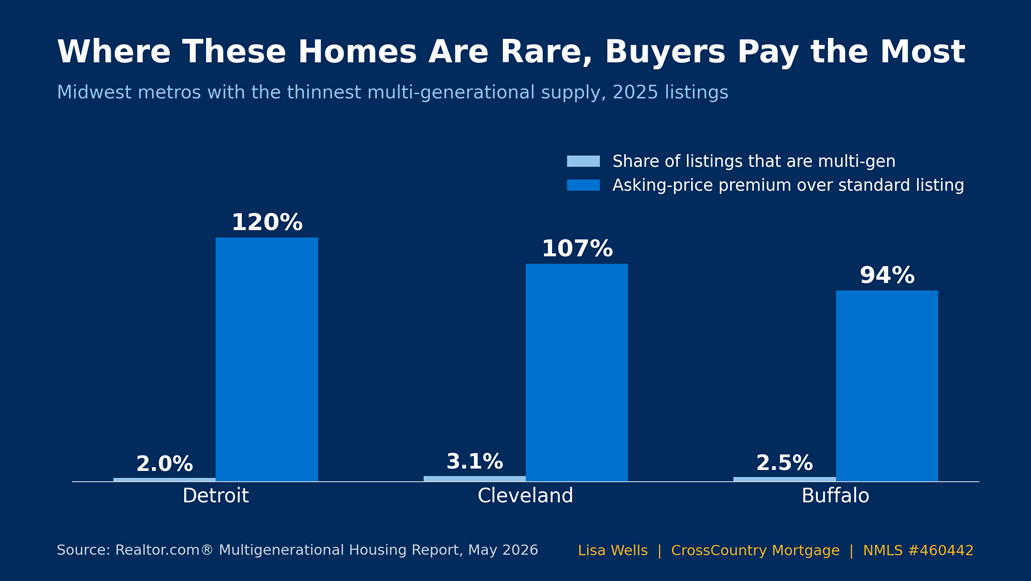
Scarcity is the whole story. In markets where these homes are everywhere, they don't command much of a premium — in Los Angeles, a multi-generational listing asks just 1.6% more than a standard one. In San Francisco, 8.4%.
But in Midwest metros where they're rare, the premiums are enormous:
Source: Realtor.com® Multigenerational Housing Report, May 2026
Detroit listings drew 82% more page views than standard homes. Cleveland, 78%. Hannah Jones, Senior Economic Research Analyst at Realtor.com, put it plainly: when these homes are a rare find and one hits the market, buyers respond — and for sellers in those markets, this type of home can be a significant asset.
The Twin Cities weren't broken out individually in that report, so I'm not going to promise you a 120% premium. But we sit in the same region, with the same thin supply and the same buyers doing the same math. The direction is not ambiguous.
Minnesota's Quiet Advantage: We Build the Right Houses
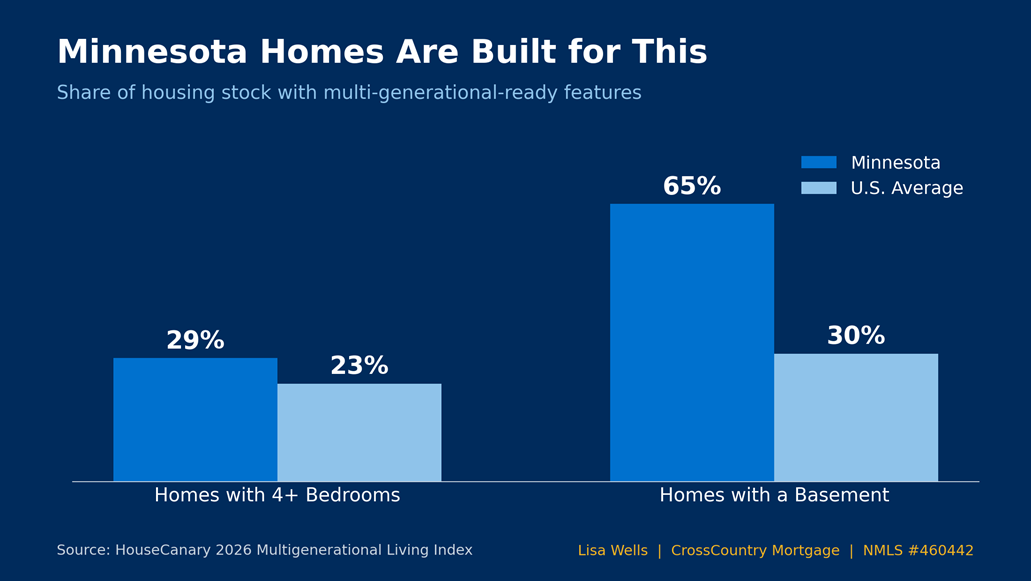
Here's the mismatch that creates the opportunity. Minnesota has relatively few families currently living multi-generationally — but our housing stock is among the best-equipped in the country to support it.
HouseCanary's 2026 Multigenerational Living Index ranks states by how structurally ready their homes are. Minnesota lands near the top, and the reason is the thing every Minnesotan takes completely for granted:
Source: HouseCanary 2026 Multigenerational Living Index
65% of Minnesota homes have a basement, versus 30% nationally. 29% have four or more bedrooms, versus 23% nationally. And upsizing here costs less — a four-bedroom home runs about 1.44× a smaller one, below the national average and far below states like Louisiana (1.86×), where basements are essentially nonexistent.
In coastal markets, making room for a parent usually means buying a bigger, more expensive house. In Minnesota, it often means finishing a lower level you already have.
Your basement isn't a storage problem. In this market, it's the most under-marketed asset in your house.
What the Premium Actually Looks Like
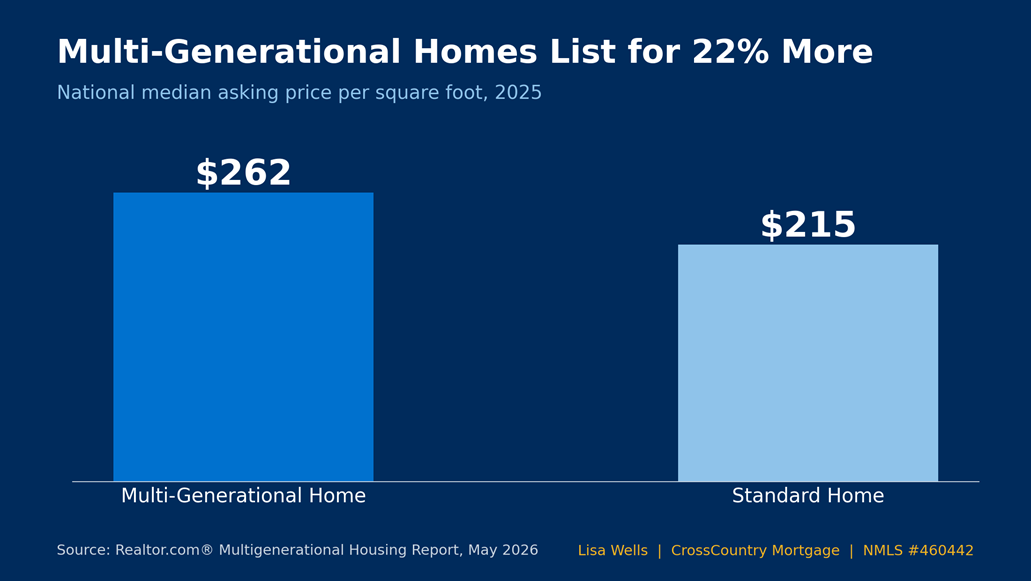
Nationally, the 2025 median asking price for a multi-generational home was $709,000 — roughly 65% higher than the $429,900 median for a standard listing. Some of that is just size. So compare them per square foot instead:
Source: Realtor.com® Multigenerational Housing Report, May 2026
$262 per square foot versus $215 — a 22% premium tied specifically to in-law suites, second kitchens, and separate entrances.
One honest caveat: that $709,000 national median is pulled upward by California and coastal markets, where these homes are concentrated and everything costs more. Don't expect it to translate directly to Blaine or Bloomington. The per-square-foot number is the more useful figure for us, and even that deserves a local reality check — which is exactly what a good listing agent's comparative market analysis is for.
And buyers aren't balking at the higher prices. Multi-generational listings pulled 13.5% more online views than standard homes and still sold in the same median 59 days.
Why This Matters Right Now in the Twin Cities
Our market has shifted, and it changes the calculus for sellers.
In July 2026, Minnesota inventory reached a seven-year high — 20,084 homes statewide, up 9.1% year over year, with 11,586 in the metro (+6.7%). Prices held up: the Twin Cities median rose 3.3% to $408,000, the strongest year-over-year gain of the year. Homes averaged 40 days on market, flat from last July, and metro sellers received 99.1% of list price.
So this isn't a bad market. It's a more selective one. Aarica Coleman, President of Minneapolis Area REALTORS®, described it as moving gradually toward balance — with conditions varying meaningfully by price point and property type.
Translation for sellers: buyers have options again. When there were four houses to choose from, everything sold. With inventory at a seven-year high, the house that solves a specific problem for a specific buyer is the one that gets the offer — and the price.
A multi-generational-capable home solves a very specific, very expensive problem. That's leverage, and it's leverage you don't get from new quartz countertops.
The Part Almost Nobody Tells Sellers: Financing Just Expanded Your Buyer Pool
This is the piece I care about most, because it's my end of the transaction and it changed recently in a way that directly affects what your house is worth.
If your home has a true accessory dwelling unit — a genuinely separate living space with its own kitchen, bathroom, and entrance — a buyer may now be able to use projected rental income from that space to help them qualify for the mortgage.
What changed
● Fannie Mae began allowing ADU rental income toward qualifying income in October 2025, with automated support live in Desktop Underwriter version 12.1 as of March 21, 2026.
● FHA has permitted it since Mortgagee Letter 2023-17, issued in October 2023.
● Freddie Mac expanded its ADU policy back in 2022 and has refined it since.
The general parameters
Typically a lender can count 75% of documented fair-market or lease rent, capped at 30% of the buyer's total qualifying income, on a one-unit primary residence purchase. Documentation runs through the appraisal plus a Form 1007 Comparable Rent Schedule.
Why you should care: a buyer who couldn't afford your house on paper eighteen months ago might qualify for it today. That's a bigger pool of people who can actually write the offer — not just admire the layout at the open house.
The catch, and it's a real one
A finished basement with a wet bar is not an ADU. The space needs separate ingress and egress, and full living, sleeping, cooking, and bathroom facilities. It also has to be zoning-compliant, or properly documented as legal nonconforming. Guidelines also vary by program and change regularly — VA, for example, handles ADU rent case by case without a published ADU-specific rule.
Before you spend a dollar framing walls downstairs to "make it an ADU," call me. A ten-minute conversation about what actually counts under current guidelines is free, and it will tell you whether that project pays for itself at closing or just costs you a summer.
What To Do Before You List
● Inventory the features you've stopped noticing. Main-floor bedroom, full bath on the main level, lower-level walkout, second kitchen or kitchenette, separate entrance, a garage stall that could serve a second household.
● Make sure they're in the listing — by name. Realtor.com's analysis identified these homes by scanning listing descriptions for terms like "in-law suite," "guest house," "ADU," and "granny flat." If those words aren't in your remarks, the buyers searching for them may never see your house.
● Stage the space for its purpose. A lower level furnished as a small apartment reads as a solution. The same room full of boxes reads as unfinished basement.
● Get the financing question answered early. Whether that space qualifies as an ADU under agency guidelines affects who can buy your home and at what price. That's a lender question, and it's better answered before you list than during underwriting.
● Price it against the right comps. This is where your agent earns their fee — these homes don't always comp cleanly, and getting that wrong in either direction is expensive.
For My Real Estate Partners
If you're taking a listing with a lower-level suite, a mother-in-law setup, or anything approaching an ADU, loop me in before it goes live.
I'll tell you in one call whether the space is likely to qualify for ADU rental income under current Fannie Mae, Freddie Mac, or FHA guidelines — which tells you how to market it, who your buyer pool actually is, and whether your seller's renovation idea is worth doing.
The same expertise applies on the buy side. My specialty is the files other lenders send back: self-employed borrowers, bank statement and asset-depletion programs, jumbo and Non-QM structures. If you have a buyer whose tax returns don't tell the whole story of their income, that's my favorite kind of phone call.
Bottom Line
Minnesota looks unremarkable on the national multi-generational map. But we have the basements, we have the bedrooms, we have the buyers doing affordability math, and we have a Midwest supply picture thin enough that the homes which fit this need genuinely stand out.
With metro inventory at a seven-year high, standing out is the whole game. If your house has space a second household could live in, that's not extra square footage — it's your strongest negotiating position.
Let's talk about what your house could be worth to the right buyer, and what financing makes that buyer possible. I'm always happy to run the numbers before you commit to anything.


All loans subject to underwriting approval. Certain restrictions apply. Call for details. CrossCountry Mortgage, LLC. is an FHA Approved Lending Institution and is not acting on behalf of or at the direction of HUD/FHA or the Federal government. Certificate of Eligibility required for VA loans. This site is not authorized by the New York State Department of Financial Services. No mortgage loan applications for properties located in the state of New York will be accepted through this site. NMLS3029 NMLS1640418 NMLS460442 (www.nmlsconsumeraccess.org).
Privacy Statement | Disclosures & Licenses | General Disclaimer | NMLS Consumer Access