
If you own a high-end home, you are in a much stronger position than most sellers right now. I say that as the person who sits on the financing side of these transactions, watching which deals get written and which ones stall out. The broader market has cooled. The top of the market has not.
Prices are up. Buyers are still writing offers. And here in the Twin Cities, the numbers are better than the national ones. But there is a catch that nobody in the headlines is talking about, and it has everything to do with how your buyer is going to pay for your house. I will get to that.
First, What Actually Counts as “Luxury”?
This trips people up constantly. Luxury is not a dollar figure that applies everywhere. Redfin defines it as the top 5% of homes by price in a given metro, which means the bar moves depending on where you live.
In the Minneapolis–St. Paul metro, the median luxury sale price came in at $1,284,400 during the three months ending May 31, 2026. Nationally it was $1,374,470. So if your Wayzata, Edina, North Oaks, or Lake Minnetonka property is sitting somewhere north of $1.2 million, you are in this conversation whether or not you think of your house as a “luxury” home.
Luxury Is Leading on Price — by a Wide Margin
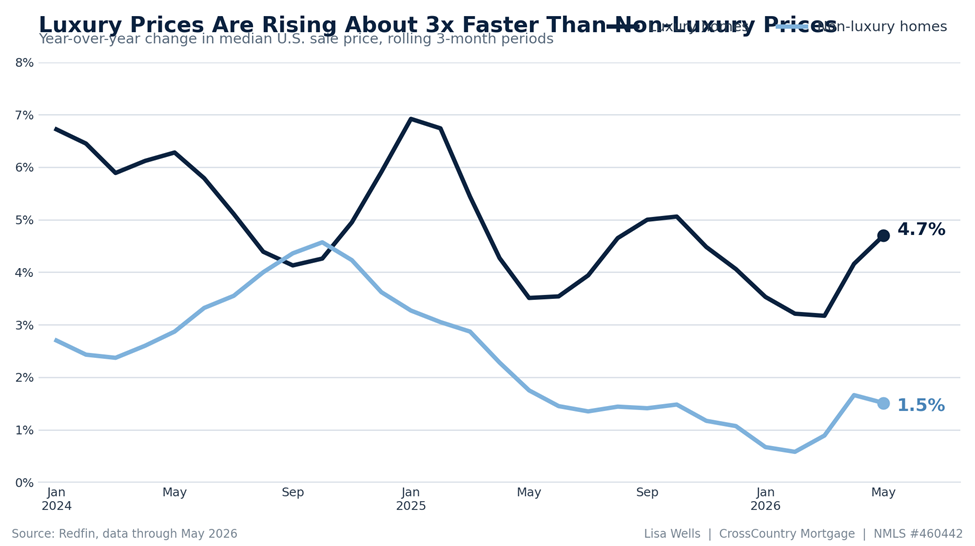
Nationally, the median luxury sale price rose 4.7% year over year. Non-luxury rose 1.5%. That is roughly three times the growth rate, and it has held up for months while everyone else has been reading headlines about a softening market.
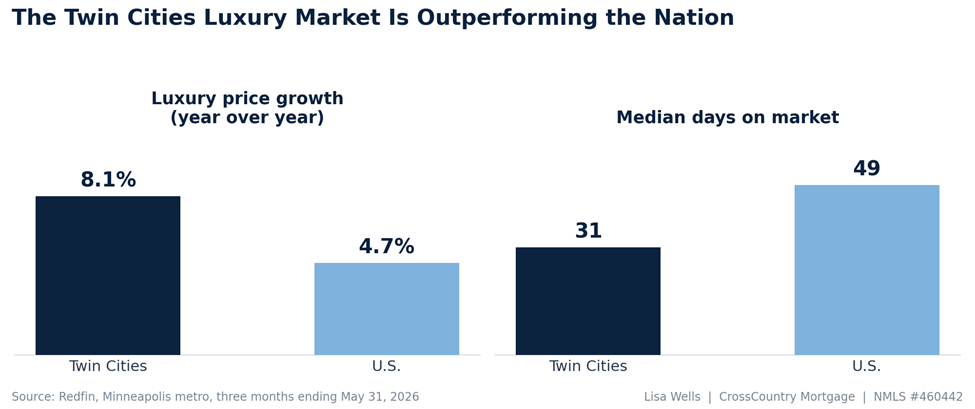
Now the local number, which is the one I actually care about. Twin Cities luxury prices rose 8.1% year over year — nearly double the national pace, and one of the stronger showings among the 50 largest metros. Minneapolis quietly outperformed Los Angeles, Boston, Seattle, and Denver on luxury price growth this spring.
That is not a story you are going to see on the evening news, because “Minneapolis luxury real estate is having a good year” does not generate clicks the way a crash prediction does.
Why High-End Buyers Keep Buying
The simple answer is that they feel affordability pressure differently than everyone else. When rates move a half point, a first-time buyer in Blaine may lose their approval. A buyer looking at a $1.5 million property in Deephaven adjusts their down payment and moves on.
Lawrence Yun, chief economist at the National Association of Realtors, framed the split by price band recently: sales of homes under $250,000 were essentially flat year over year, upper-price-tier sales were up around 10%, and sales above $1 million were up roughly 18%. The higher you go in price, the more activity you find.
The dividing line in this market is not buyer versus seller. It is price point.
I see the same pattern in my own pipeline. My conversations at the high end are about structure, timing, and tax strategy. My conversations at the entry level are about whether the payment works at all. Those are two completely different markets sharing one set of headlines.
Speed: The Honest Version
Here is where I am going to push back on how this story usually gets told.
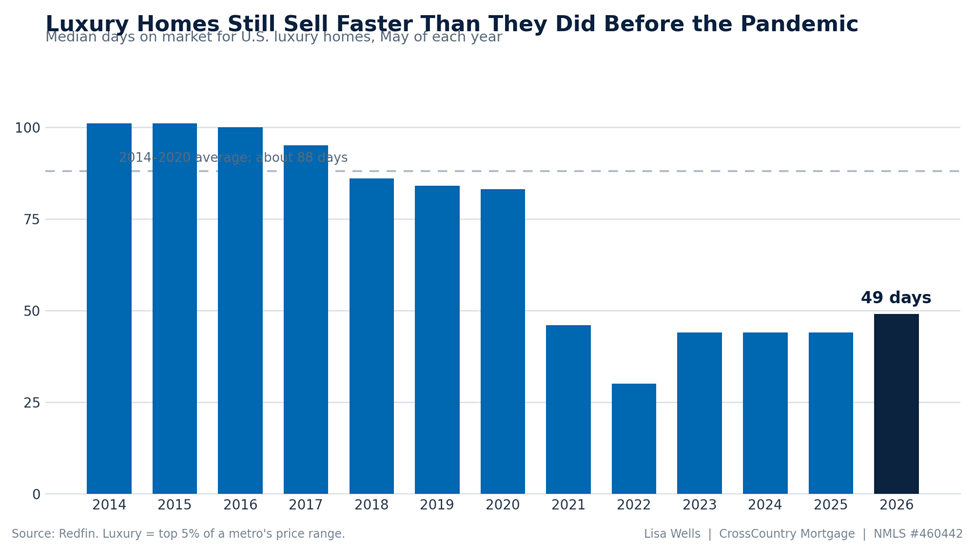
Yes, luxury homes sell faster than they did before the pandemic. Nationally, the median luxury home went under contract in 49 days during the three months ending May 31. Compare that to the 80- to 100-day stretches that were normal from 2014 through 2020, and it is a meaningful improvement.


All loans subject to underwriting approval. Certain restrictions apply. Call for details. CrossCountry Mortgage, LLC. is an FHA Approved Lending Institution and is not acting on behalf of or at the direction of HUD/FHA or the Federal government. Certificate of Eligibility required for VA loans. This site is not authorized by the New York State Department of Financial Services. No mortgage loan applications for properties located in the state of New York will be accepted through this site. NMLS3029 NMLS1640418 NMLS460442 (www.nmlsconsumeraccess.org).
Privacy Statement | Disclosures & Licenses | General Disclaimer | NMLS Consumer Access