
You’re scrolling listings on your phone. The house looks great. Then you see the price — or worse, the estimated monthly payment — and you close the app.
I hear about that moment constantly. Usually months after it happened, when someone finally calls me and opens with, “We’ve been assuming we can’t afford anything right now.”
Here’s what I tell them: that assumption is probably out of date. Nationally, there are more homes sitting on the market than there are buyers out looking. When sellers need buyers more than buyers need sellers, it shows up in the price. And in the Twin Cities specifically, it’s showing up somewhere even more valuable — in your leverage.
More Than 4 in 10 Sellers Nationally Have Cut Their Price
One of the clearest signals that sellers are adjusting is the price reduction rate. HousingWire Data puts it above 40% — 41.4% at last read, running just slightly behind the same stretch last year.
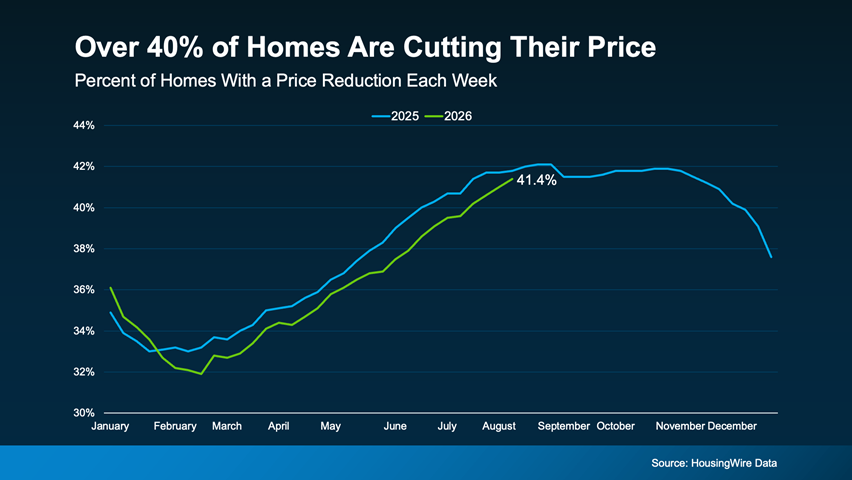
That’s more than four out of every ten listed homes. Sit with what that represents: thousands of sellers who decided they’d rather lower the ask than keep waiting for someone willing to stretch past their budget.
They know that selling requires give and take. When nobody’s biting, they pull the biggest lever they have.
And the Sellers Who Haven’t Cut Are Starting Lower
What about the other six in ten? A lot of them never tested a high number in the first place. They priced realistically on day one rather than list high and hear crickets.
That’s a big part of why July 2026 posted the lowest median national list price of any July in five years — $428,950, according to Realtor.com. That’s the white line below.
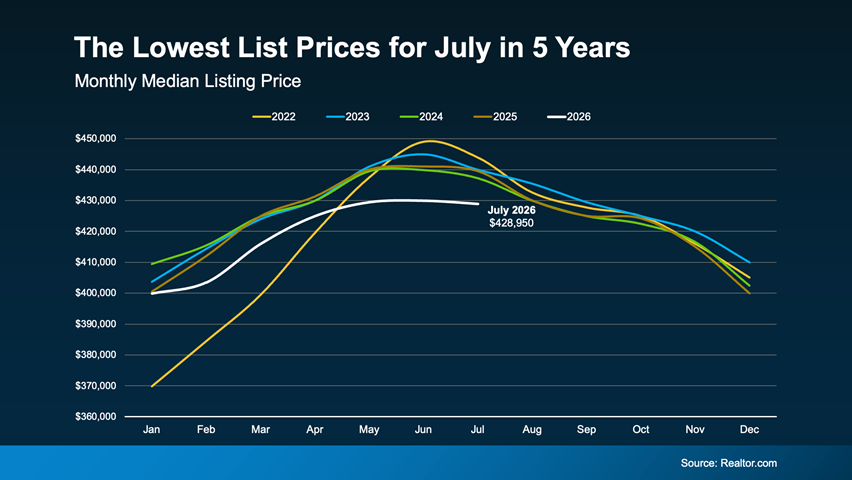
This is not a crash, and I won’t sell it to you as one. Prices nationally are still well above where they were before the pandemic. What it means is that sellers stopped pricing for a bidding war that isn’t coming and started pricing for the buyer who actually exists.
Now Here’s the Part the National Headlines Leave Out
Minnesota is not the national market. I’d rather you hear that from me now than figure it out mid-negotiation.
Here’s what actually happened here in July, per Minneapolis Area REALTORS® and Minnesota Realtors:
● Inventory rose 6.7% to 11,586 homes — the highest July supply in seven years
● Months’ supply climbed 7.1% to 3.0 months, with new listings up 8.0%
● Days on market held flat at 40, and closed sales jumped 10.5%
● The median sales price rose 3.3% to $408,000
● Metro sellers still received 99.1% of list price — down only slightly from last July
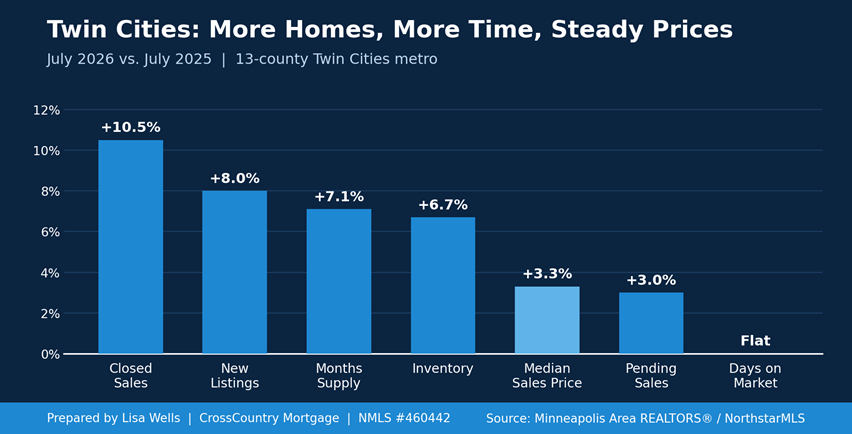
Read those last two bullets again, because they matter. Our sellers are still collecting essentially their full asking price, and our median price went up.
So no — I’m not going to tell you Twin Cities sellers are capitulating. Most of them aren’t. Minnesota Realtors described this July as the most balanced market we’ve seen since 2017, and “balanced” is the right word. It isn’t a fire sale.
What changed in our market isn’t price. It’s leverage — and leverage is the part you can actually negotiate with.
You have more homes to choose from than in any July since 2019, more time to make a decision without someone breathing down your neck, and more room to ask for things. That’s a materially different buying experience than 2021, even with a median price that went up.
Where the Leverage Actually Is — By Price Point
“Is it a buyer’s market?” has a different answer depending on what you can spend, and this is where I spend most of my time with clients. Looking at months’ supply by price band in NorthstarMLS data for July:
● $250K–$350K is the tightest segment in the metro. If that’s your range, expect competition. Get fully underwritten before you write — not pre-qualified, underwritten. It’s the difference between an offer a listing agent takes seriously and one they use as leverage against somebody else.
● Everything from roughly $150K to $1M still sits in seller’s-market supply, though with meaningfully more breathing room than a year ago.
● Above $1M has moved into buyer’s-market territory. That segment now carries more supply than demand — and for my jumbo and self-employed clients, that’s the most favorable negotiating position I’ve seen in this price range in several years.
● Condos and townhomes carry the highest months’ supply of any property type. If a condo works for your life, you have real room to negotiate right now.
Same metro. Same month. Four completely different negotiating positions. Anyone telling you “the market” is doing one single thing isn’t looking closely enough.
The Move Most Buyers Miss: Negotiate Terms, Not Just Price
Here’s something I see play out constantly. A seller who will not budge another dollar on price will often say yes to a closing-cost credit — because it protects their comp and their appraisal while still getting the deal done.
That credit can be applied to a permanent rate buydown or a temporary buydown structure that lowers your payment in the early years. On a $408,000 purchase, the monthly difference is usually more meaningful than the price reduction you were fighting for. Sellers frequently prefer it, and most buyers never think to ask.
That’s the conversation I want to have with you before you write an offer — not after.
For My Agent Partners
If you’re working buyers right now, the national “sellers are slashing prices” storyline is going to walk into your showings with unrealistic expectations attached. The honest local answer — more choice, more time, more negotiating room, but sellers still getting 99.1% of list — lands better and protects your credibility.
Send me your buyer and I’ll run the numbers by price band, structure the concession ask so it survives underwriting and appraisal, and get them fully underwritten before you write. I’m also glad to run a short market-and-financing session for your team or your next client event. My team of five has been doing this a long time, and we answer the phone.
Bottom Line
Twin Cities sellers aren’t desperate. But they are more flexible than they’ve been in seven years — on timing, on terms, on concessions, and in some price ranges, on price.
If you’ve been assuming everything is out of reach, let’s actually check. It takes one conversation to find out whether that’s true, and I’d rather you know than keep guessing from a listing app.


All loans subject to underwriting approval. Certain restrictions apply. Call for details. CrossCountry Mortgage, LLC. is an FHA Approved Lending Institution and is not acting on behalf of or at the direction of HUD/FHA or the Federal government. Certificate of Eligibility required for VA loans. This site is not authorized by the New York State Department of Financial Services. No mortgage loan applications for properties located in the state of New York will be accepted through this site. NMLS3029 NMLS1640418 NMLS460442 (www.nmlsconsumeraccess.org).
Privacy Statement | Disclosures & Licenses | General Disclaimer | NMLS Consumer Access